I have a friend who is selling off most of her antique quilt collection. A few years ago I told her she had one I wanted so if she was ever ready to sell it, to let me know.
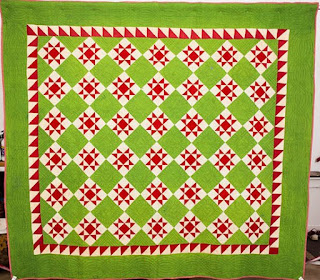
Now it's mine:
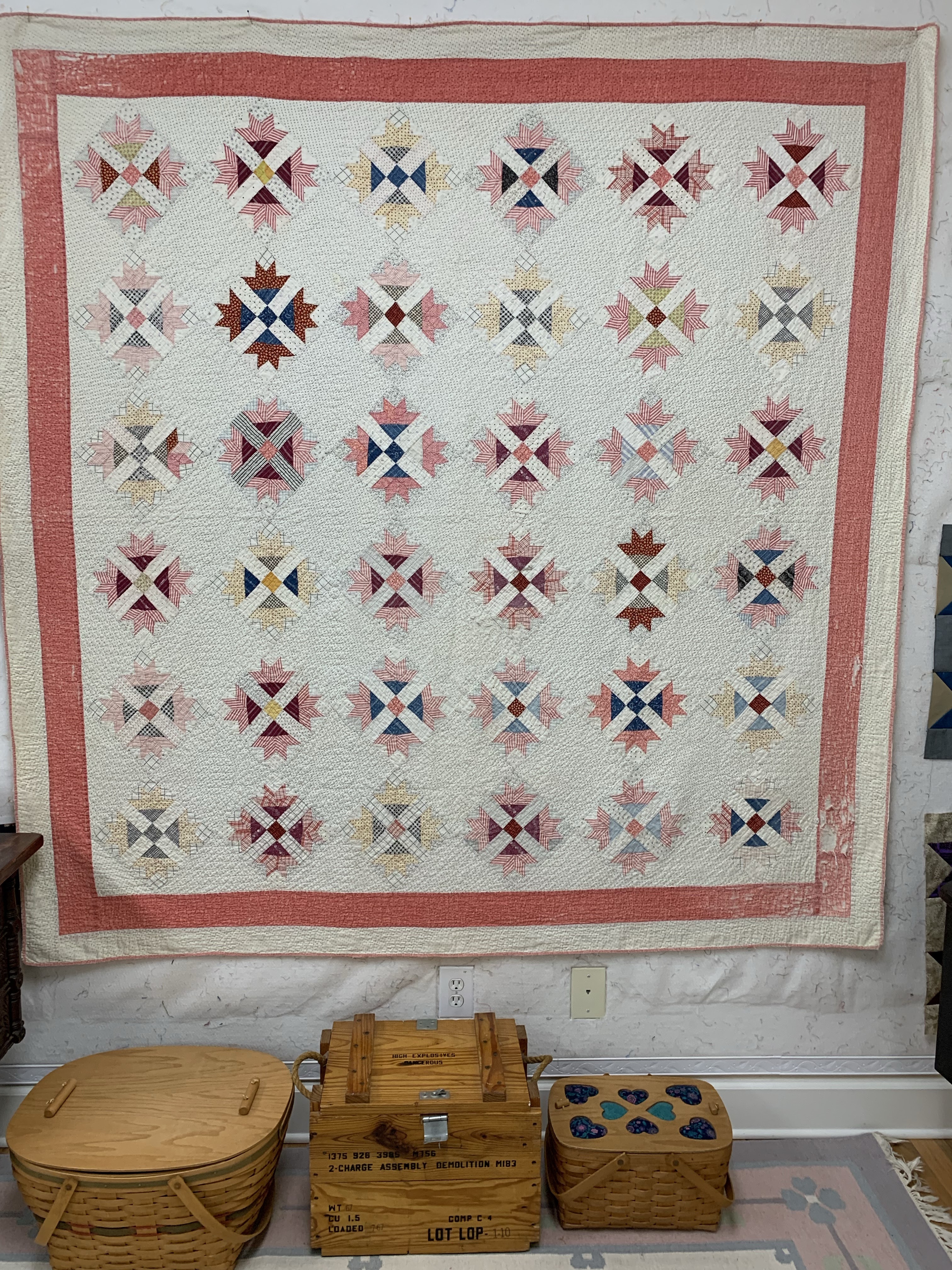 |
| 76" square |
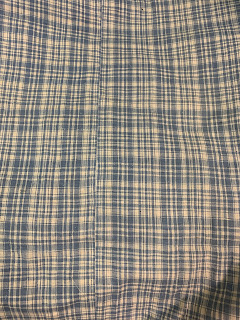
It is well-loved and very worn in spots. But I still love it so. The hand quilting is inspiring, 10 stitches/inch, so tiny and even. The soft colors appeal to me, as do all the various shirting fabrics used as backgrounds.
I like that sometimes there are several fabrics in the same position. Maybe this block was one of the last to be made and the original quiltmaker was determined to use up the pieces she had already cut. I do that with scrap quilts:


Red/cheddar with indigo blue:

Pink and green, with a red center:

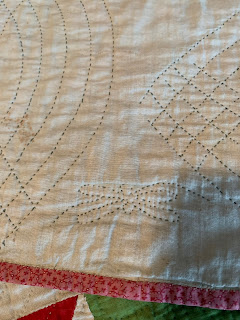
There are quite a few yellows too, and a few plaids, always good for movement in a quilt. Here you can clearly see the damage on the outer pink border:

As I often do, it is my plan to reproduce this quilt to honor the original maker, sadly "anonymous" to us. The seller tells me it came from Indiana, that is all we know about it. PLEASE label your quilts with the who, what, why, when and where!!


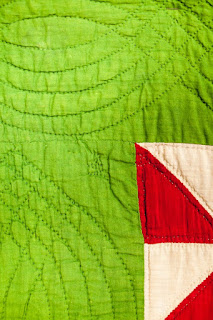
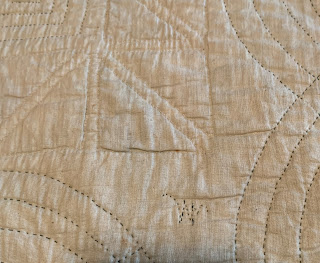
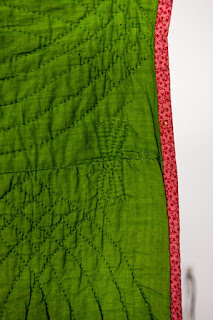
The hand quilting is wonderfully small and even. There are lots of straight lines, and a beautiful feathered wreath in the large blocks. The outer borders have a lovely feather vine too. I LOVE FEATHERS! I will do my best to replicate the hand quilting when my reproduction quilt is finished:
 |
| The back because the shirtings on the front make it hard to see the quilting |
 |
| You might be able to see the Feathered Wreath in this large block |

The block is called Goose Tracks or Cross and Crown. They are 7.5" finished. First, I pulled fabrics from my substantial stash that resemble the original fabrics. I did the math for a 9" block, cut a few blocks out, and got to work. Here are the first two:

Expecting to use this as a new class sample, once I made these two blocks I thought long and hard about that plan. The points are 45 degree diamonds, and the background squares and triangles are "set-in" with Y seams. Most people don't want to fiddle with a pattern they consider "difficult".
I often say about a pattern like this: "It's not hard, it's just not fast". And that is very true. It doesn't bother me to make such a block if just to prove that I can. But not everyone feels that way.
So I selected another, "easier" block that feels like Goose Tracks. It has several names: Duck and Ducklings, Hen and Chickens, Wild Goose Chase, Fox and Geese, Corn and Beans.
I did the math for a 7.5" finished block--the cutting measurements are very easy at that size and it replicates the feel of the original quilt.
They sew up quickly--especially because I use a really fast technique taught by Debbie Caffery in her book SCRAPS TO YOU, TOO. It makes two Bird in the Air blocks at once and four are needed for each block. Cut two sets and you have them ready to go. They are sometimes referred to as "Mary's Triangles" though I don't know who Mary was.
Here are the first four:

So, now, apparently, I am making BOTH of these quilts. One to replicate the antique and one to teach.
UPDATE: A brilliant friend reminded me of the Carolina Lily block that has a similar feel to Goose Tracks but is much easier to make. Amazing! How did I forget about that?! I love making Flying Geese, four at a time (see Tutorial for my method above in TUTORIALS) and this method uses 8 Flying Geese per block. Thanks, Ellen!
Now I can make 7.5" blocks as a tribute to the original quilt:


Here is the current "Fabric Pull" I am working with. If I get bored, I'll open the closet and add some more. What is the point of having all this fabric if I don't use it?

What do you think? Is the original block too hard or fiddily for you? Which do you prefer? Do you ever reproduce a beloved quilt just to save it?
The value of an antique quilt is based on several factors but condition is very important. I did not pay a lot for this quilt but it is precious to me. In pristine condition it would have been out of my price range. Now I get to love and care for it until it goes to live with someone else someday.
Let's quilt.
Barbara