Showing posts with label hand quilting. Show all posts

Sunday, December 1, 2024

MONTH 12 -- THE QUILTING AND FINISHING

PICK A PETAL is the 2024 Block of the Month quilt designed by Jen Kingwell exclusively for The Quilt Show. It is FREE to Star Members, join today to take advantage of this great bonus. WATCH Jen's Show to see how she makes this quilt--it is FREE for EVERYONE all of 2024: Jen Kingwell Show 3401 

IMPORTANT REMINDER:  the patterns for Pick a Petal are available FREE to Star Members of The Quilt Show through December 31, 2024. Be sure you have saved/printed/backed up the files if you need them after that date. Any files you don't have will have to be purchased directly from the designer. No one here can give them to anyone, the rights to the pattern return to the designer per the contract. We protect the copyright of our designers who continue to create wonderful quilt designs for the exclusive use of The Quilt Show  Star Members for a specific amount of time.

This month the pattern instructions show how to assemble various parts of the quilt. Most of us did this as we were making the quilt. If you are ready for the quilting, it's time! 

Be sure to watch Show 3401 while it is free to Star Members, through December 31, 2024. Jen talks about her quilting designs and shows some details of the free-form quilting she did with decorative thread. She doesn't have a plan for specific motifs quilted in specific places. It appears she did what the quilt told her it wanted in any given area.

Here are some detail shots that may assist you as you do the quilting on your own Pick A Petal:


Some of the visible stitching is additional embroidery added to just the top, not quilting lines that go through all three layers. Some of the visible stitching is hand quilting, that does go through all three layers. I leave it to you to decide how you want to enhance your quilt with your quilting.

In addition, the Month 12 pattern contains Jen's instructions for how she added a FACING, to finish the completed quilt, rather than an applied binding. I plan to  try that on a small quilt I will soon have finished. A FACING is a nice way to treat the edge of a quilt when a binding might detract. 

The FACING brings the front of the quilt to the back without adding a binding. Here you can see additional rows of hand quilting at the very edge of the quilt. People will wonder how you did that outside edge! 


I hope you have enjoyed Pick A Petal this year. Now it's time to pull my fabrics for Laurel Ridge--the 2025 Block of the Month Quilt designed by Lynn Wilder exclusively for The Quilt Show. Be watching for a post about how you can be prepared to get started in January 2025 when Laurel Ridge hits the website! 

Grandmother's Autumn

Granddaughter's Spring


I am making mine with Granddaughter's Spring and some additional fabrics. Be watching for that soon.

Let's quilt!

Barbara


Sunday, September 17, 2023

HAND QUILTING

I enjoy hand quilting. Because it takes so much more time than machine quilting I don't do it a lot.

Recently I completed a small quilt I hand pieced and hand quilted, HEXIE STARS:

40" x 40" 

Detail 

It has wool batt, making it easy to hand quilt, and very soft. The downside to wool is that it costs more and should not be dried in a hot dryer. I always indicate on my label if a quilt has a wool batt and that it should be air-dried. This label was made 2 years ago so needed an "update" when I finally finished this quilt:

A few weeks ago I wrote about a New OLD Quilt I recently bought. As I like to have a handwork project available for "slow stitching" in the evenings, I put a small quilt together last week. It is a tribute to the antique.  While I AM making a full-size reproduction of the original, the Goose Track blocks are a variation style so the blocks are easier to piece. I did make 4 Goose Track blocks with Y-seams, as the original maker did hers, but knew few people would want to do that. 

So here is what I am doing with those 4 blocks. I wanted to replicate the quilting motifs used in the original quilt, feathered wreaths in the blocks and feathered plume vines in the borders. Rather than use shirting fabrics for the background, I used white so you can really see the quilting. And wool batt is so easy to quilt through: 


A few more of the quilts I have hand quilted include:

42" x 42" 
        
Detail--black thread

Detail
If you are new to hand quilting, start small, there is a learning curve:

14" x 15" 

This one took me 7 years to complete. It won Best of Show, Heritage Quilters of Huntsville, 2011:

    A-Round With My Friends, 68" x 68" 


If you want speed, try Big Stitch quilting. I find it faster than fine hand quilting. It uses thicker thread, I like Perle cotton size 8, a large needle and doesn't take too learn to learn. Here are a couple I have quilted with Big Stitch:

Antique Rose Star, 76" x 76"


Charming Sampler Red 33" x 33" 


Recently a great student friend asked if I would offer a hand quilting class locally as she wants to improve her hand quilting skills. Not expecting much interest from local shops and knowing it would be months before that could be arranged, I offered a "Pop Up" two hour class in my home. With only a few days notice we got one other interested student. 

Mazie and Betina came and had good time while learning a variety of tips for both fine hand quilting and Big Stitch quilting. I dug out lots of threads and other tools, and gave them each a simple "sandwich" with wool batt to try. See those smiles:

Betina and Mazie


Some tools of the trade


Do you hand quilt? It does make for a cuddly quilt--it uses half as much thread as machine quilting. It can be hard on aging hands so I save it for very special quilts, and use a "hybrid" method--I do machine Stitch in the Ditch quilting first, to anchor seams and provide stability to the quilt. Then I hand quilt where it can really be seen and appreciated. Works for me.

Let's quilt.

Barbara

Sunday, August 13, 2023

A "NEW" OLD QUILT

 I have a friend who is selling off most of her antique quilt collection. A few years ago I told her she had one I wanted so if she was ever ready to sell it, to let me know.

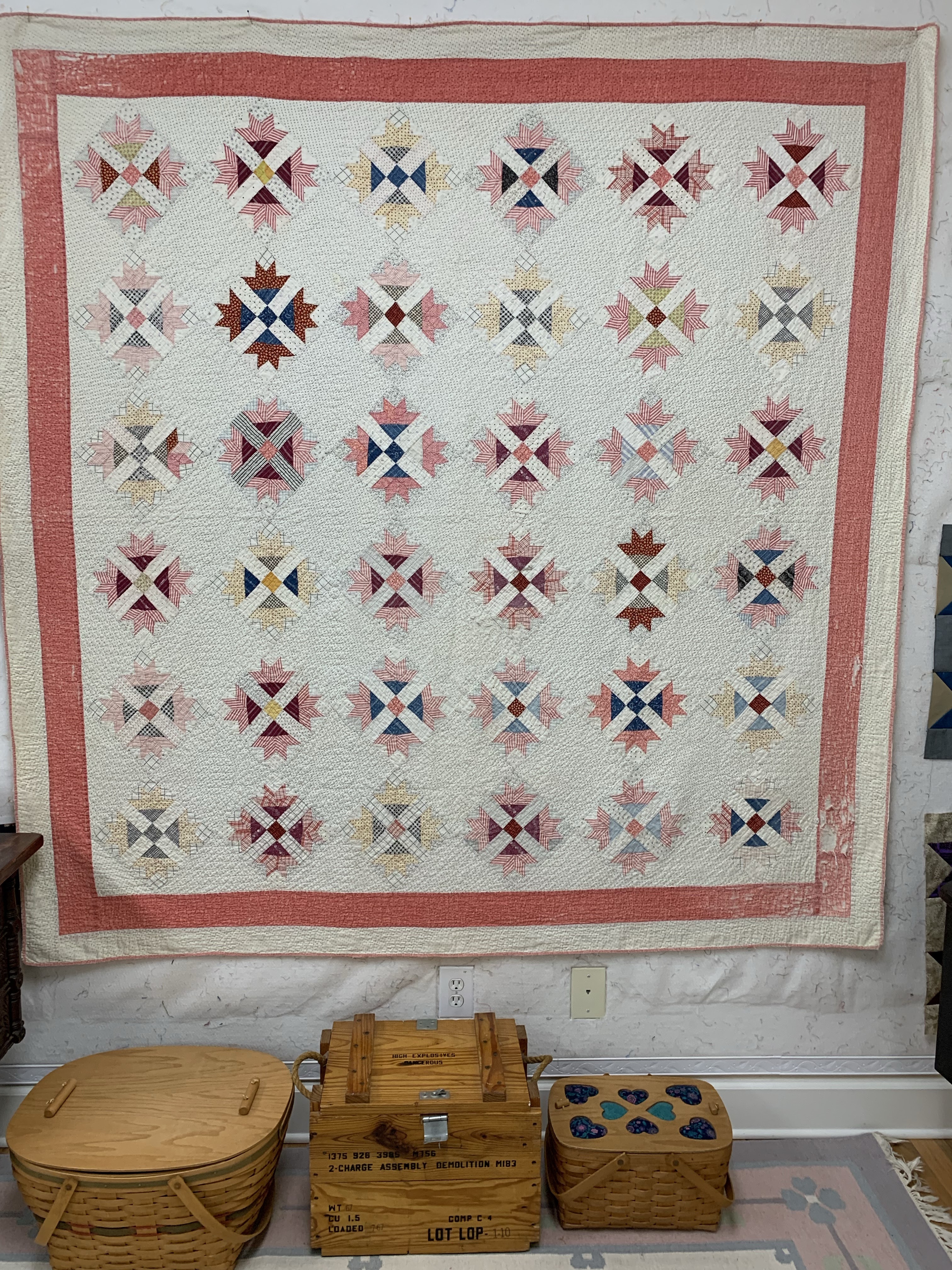
Now it's mine: 

76" square

It is well-loved and very worn in spots. But I still love it so. The hand quilting is inspiring, 10 stitches/inch, so tiny and even. The soft colors appeal to me, as do all the various shirting fabrics used as backgrounds.

 I like that sometimes there are several fabrics in the same position. Maybe this block was one of the last to be made and the original quiltmaker was determined to use up the pieces she had already cut. I do that with scrap quilts: 


Sometimes all the fabrics in each position are the same or very close. The pink/white stripe is used quite a lot and it adds movement.:


Red/cheddar with indigo blue: 

Pink and green, with a red center: 

The hand quilting is wonderfully small and even. There are lots of straight lines, and a beautiful feathered wreath in the large blocks. The outer borders have a lovely feather vine too. I LOVE FEATHERS! I will do my best to replicate the hand quilting when my reproduction quilt is finished:

The back because the shirtings on the front make it hard to see the quilting

You might be able to see the Feathered Wreath in this large block

There are quite a few yellows too, and a few plaids, always good for movement in a quilt. Here you can clearly see the damage on the outer pink border: 

As I often do, it is my plan to reproduce this quilt to honor the original maker, sadly "anonymous" to us. The seller tells me it came from Indiana, that is all we know about it. PLEASE label your quilts with the who, what, why, when and where!!

The block is called Goose Tracks or Cross and Crown. They are 7.5" finished. First, I pulled fabrics from my substantial stash that resemble the original fabrics. I did the math for a 9" block, cut a few blocks out, and got to work. Here are the first two:


Expecting to use this as a new class sample, once I made these two blocks I thought long and hard about that plan. The points are 45 degree diamonds, and the background squares and triangles are "set-in" with Y seams. Most people don't want to fiddle with a pattern they consider "difficult". 

I often say about a pattern like this: "It's not hard, it's just not fast". And that is very true. It doesn't bother me to make such a block if just to prove that I can. But not everyone feels that way.

So I selected another, "easier" block that feels like Goose Tracks. It has several names: Duck and Ducklings, Hen and Chickens, Wild Goose Chase, Fox and Geese, Corn and Beans. 

I did the math for a 7.5" finished block--the cutting measurements are very easy at that size and it replicates the feel of the original quilt. 

They sew up quickly--especially because I use a really fast technique taught by Debbie Caffery in her book SCRAPS TO YOU, TOO.   It makes two Bird in the Air blocks at once and four are needed for each block. Cut two sets and you have them ready to go. They are sometimes referred to as "Mary's Triangles" though I don't know who Mary was. 

Here are the first four: 


So, now, apparently, I am making BOTH of these quilts. One to replicate the antique and one to teach. 

UPDATE: A brilliant friend reminded me of the Carolina Lily block that has a similar feel to Goose Tracks but is much easier to make. Amazing! How did I forget about that?! I love making Flying Geese, four at a time (see Tutorial for my method above in TUTORIALS) and this method uses 8 Flying Geese per block. Thanks, Ellen!

Now I can make 7.5" blocks as a tribute to the original quilt: 


I have already made 4 blocks 9" using the set-in seams Diamonds method--they will become a small wallhanging. The reproduction quilt will be made from these "Goose Tracks Variation" blocks, 7.5":

Two Flying Geese and a Half Square Triangle and Viola! The look is the same and from any distance will look exactly like the original: 


Here is the current "Fabric Pull" I am working with. If I get bored, I'll open the closet and add some more. What is the point of having all this fabric if I don't use it?


What do you think? Is the original block too hard or fiddily for you? Which do you prefer? Do you ever reproduce a beloved quilt just to save it? 

The value of an antique quilt is based on several factors but condition is very important. I did not pay a lot for this quilt but it is precious to me. In pristine condition it would have been out of my price range. Now I get to love and care for it until it goes to live with someone else someday.

Let's quilt.

Barbara


Sunday, November 6, 2022

MY FAVORITE QUILTS # 4

 One of my favorite quilts hangs on the Living Room wall most of the year so I can enjoy it.


A-ROUND WITH MY FRIENDS: 67" X 67" 2011

For several years I made "Round Robin" quilts with two friends, Ellen and Sharon. In 2004 on a trip to Alaska I bought the same fabric in three colorways for one of those projects. The fabric is the one used as my outer border. Each of us made a center block of our choosing, then we passed that and our fabrics on to each other for the next border to be added. We could add fabric to the quilt, it just had to look like it belonged with the other fabrics.

I started with my beloved Feathered Star, a block I have used several times in medallion style quilts. I love the elegance and challenge of this block with many pieces. 

Ellen added the large poppies and border beyond the poppies. Sharon added the sawtooth border and the gold area. When I got it back I loved it so much and knew it deserved to be larger. 

Over the next 7 years I worked on the appplique border, inspired by a Nancy Pearson design. I drew all the flowers, cut all the templates, made miles of narrow bias stems, and hand appliqued for years to get it done.

Then I hand quilted it. Wool batt is lovely to hand quilt on and I enjoyed every stitch. But it's time consuming and life was busy then so it was 7 years before I finally finished this quilt. 

The timing was perfect. It was ready for my guild quilt show in 2011. It was awarded Best of Show that year. The following year it was juried into the American Quilt Society show in Paducah, KY. In 2014 it was selected as one of the 500 best Traditional Quilts featured in a book by that name. And it was included in the Special Exhibit of many of the quilts from that book at International Quilt Festival in Houston 2014. 

Here are some detail shots:


Not my usual colors, but this quilt just came together, one step at a time, and I love everything about it. 

I am not sure if I will ever hand quilt a bed size quilt again so that makes this one that much more special.

Let's quilt.

Barbara


Wednesday, October 26, 2022

MY FAVORITE QUILTS # 2

In the 1990's I made a lot of bed size quilts and when I think of how busy life was then, with kids, the house, several jobs, and a husband to keep happy I really don't know how I did it all.

Of course, I was younger then, a lot younger. And quiltmaking was absolutely my passion by then. I HAD to  make quilts, there was no other option. That remains true to this day.

Here is the story of another of My Favorite Quilts. 

LONE STAR GARDEN, 1997, 90" X 90" 


Detail 

The center star was inspired by an antique quilt in the book Star Quilts  by Mary Elizabeth Johnson. Each of the 8 very large diamonds is cut from a border stripe fabric, and each has to be cut exactly the same as the rest. I bought 5 yards of the Jinny Beyer border stripe and got started.

I had to return to the store to buy more yards--those diamonds are huge. I finally got all 8 diamonds pieced together, each is a single piece of fabric. The beauty of using a border stripe is the center will be a big surprise. I didn't know what it would look like until all 8 diamonds came together. I loved it.

I designed the applique blocks/triangles with inspiration from the book Jacobean Designs  by Pat Campbell. Using some of my most favorite fabrics, I cut flowers and leaves and stems for weeks. The hand applique process took months of stitching at night, mostly. 

When the center of the quilt was done it was time to figure out a border. It would have been simple to throw more of the border stripe on and call it done. But, no, this quilt deserved something more challenging than that.

Jinny Beyer had developed a technique she called "Soft Edge Piecing" and had written a book by that name. I knew that was just perfect for this quilt. So I went back to the store and bought the rest of the bolt--by now I had purchased close to 15 yards of this one fabric for this quilt.

I  hand basted the border stripe to a length of the pink background fabric. Then did that 3 more times to prepare the borders. Over many hours I slowly cut on a line on the border stripe, turned it under and hand appliqued the border stripe to the background. This is "soft edge piecing", an appliqued edge on a base fabric.

While it was completed in 1997 I know I worked on it for about two years. I marked it for quilting and took it to a woman who has doing hand quilting for the public back then--she quilted quite a few quilts for me in those years. She liked my quilts because I brought them marked and basted so all she had to do was quilt them. And regardless of the price she asked, I paid her in cash, the amount she asked, AND fabric. She didn't drive and getting out to a store was difficult so she loved having a big bag of fabric to use for her own quilts. 

This quilt was the first I  had exhibited at International Quilt Festival in Houston, It was included in the Special Exhibit "Traditional Treasures" in Houston, 2013. It was a thrill to see it hanging there.


This quilt taught me that a great quilt doesn't get made in a day. Lots of stitches, and time, will make a great quilt, just keep going. Learn new techniques, read a lot of books, get inspired by quilts from the past. And make it your own.

Let's quilt.

Barbara