Showing posts with label Barbara Brackman. Show all posts

Wednesday, November 11, 2020

Big Top Finished

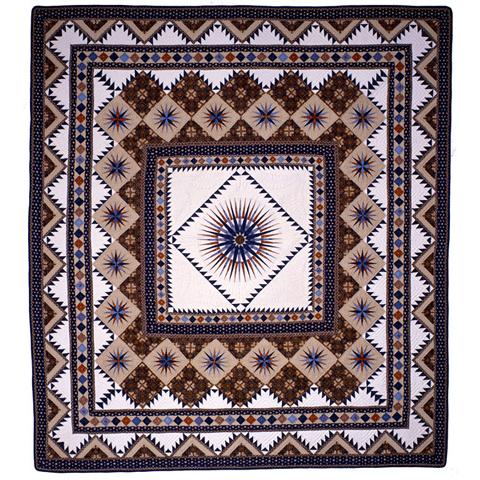
 Ever since I saw a photo of an antique quilt I loved on a friend's post I have wanted to make that quilt. Fortunately, a published pattern already existed for it so I didn't have to reinvent the wheel.

This is my version, 111" square, of the wonderful old quilt:


Here is the original photo that inspired me:


The primary change I made, other than size, was to add cheddar cornerstones at the sashing intersections instead of the double geese in the original. I really struggled with that decision. I really wanted to be true to the original maker's design. But, as I tell my students all the time, "It's Your Quilt--You Get to Decide". So, I did.

Eventually, I'll get this really BIG quilt basted and begin quilting it. The back took 10 yards of fabric--good way to empty a bolt that has been in my closet for years.

Now, since I really want to be true to the original, I have started a second one--a much smaller sample that can easily travel when I get to teach this to some lucky guild, sometime in the future. Here is just a taste:


Big, bold, bright--very different. All the geese are the same dotty fabric, all the star points in the blocks are the same fabric, a white/black print. The blocks will have a wide variety of bright prints. 

Often, people cannot picture what a quilt will look like made with fabrics different from the sample. For those who don't love Civil War reproduction fabrics, here is an alternative. This sample will be 45" square.

For more information about this quilt, see an earlier blog I wrote about it Here.

And, just one more thing--today in the US is Veteran's Day, set aside to salute all US veterans of all branches of our military service. As a former United States Marine, I salute all who have served in the past, are serving now, and will step up to serve in the future. Semper Fi!

A few years ago...


Let's quilt.

Barbara


Sunday, October 11, 2020

Decision Made

 Working on Western Sun, a pattern of an antique quilt that I have always loved, I was torn between staying true to the original design layout or using a cheddar cornerstone between the rows of Flying Geese sashing. I wrote about this recently here, and here.

A few people liked the cheddar cornerstone, and no one spoke in defense of the original so I went with the cheddar. Eager to get started sewing the top together, I first worked on a color layout design once all 25 of the full blocks were done.

To be able to see them all, I just put them on the design wall without space for the sashing. After snapping a photo to refer to, I was good to go. 


I made one corner block, a quarter block, for the upper left corner and made a few half blocks for the perimeter triangles so I could start. Let the assembly begin:


Scrap quilts are my favorite kind and I  have made many over the years. First, I pull fabrics for a "palette", then start cutting the required size pieces I need. As I worked on this, I knew I would need to cut more fabrics, but how much more?  Once I got this far, I could easily see and count blocks that were left to make and figure out how much to cut. 

Here is what is cut and on hand currently:

So, I "did the math" and about all I need to cut is the parts for the Flying Geese sashings. I need to cut 183 "geese", from 46 squares--they are Quarter Square Triangles. Then I need to cut 333 pairs of "wings" from squares--that's a lot of cutting. But I am happily using up some favorite fabrics that have lived here way too long. 

Using Electric Quilt 8 (EQ8) helps me so much when playing around with quilt design. The book this pattern is in, Butternut and Blue by Barbara Brackman and Karla Menaugh, has the quilt at 45" square, with only 5 full blocks. Mine is 110" square, if I add the border I think I will add, so it's a lot different.

Here is my sketch of the original design in EQ8--the sashing is ALL geese:


And the sketch with the cheddar cornerstones that I ultimately decided to use:


I don't try to match fabrics very carefully in EQ8 with my quilt designs because I use so many different fabrics and adding lots of them to the project file makes it really BIG. I just try to get the feel for what the quilt will look like overall. In this second one, I did work with color placement since all 25 of the full blocks were done and they all  had to go somewhere. 

Back to cutting out fabric and making the remaining 7 half blocks, 3 corner blocks and all those flying geese sashing units. I'll be in the Studio, if you need me...

Let's quilt,

Barbara


Sunday, September 27, 2020

Big Circles

 My current project, Western Sun, has BIG circles. I thought you might like to see how I am making them.

See the first post I wrote about this project here: Western Sun

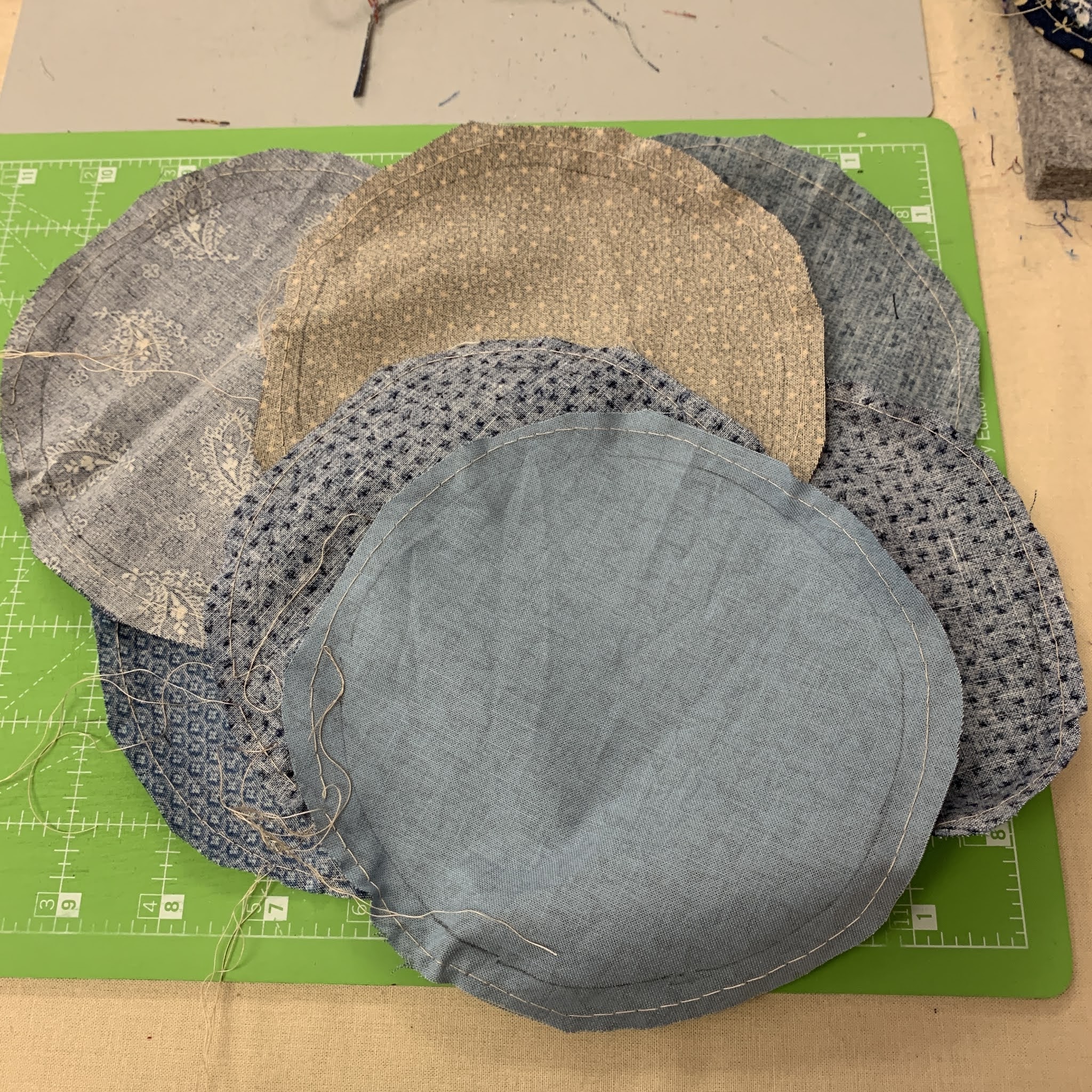
1. Cut out large squares, 3/4" larger than the finished circle. I used Templar, heat resistant template plastic, to cut a circle the finished size. Trace around the circle on the back side of fabric:


2. Trim excess fabric away, leaving about 3/8" seam allowance. Use a long stitch on the sewing machine to run gathering stitches in the seam allowance--be sure to leave long thread tails:


3. Pull the bobbin threads snugly around the template, press firmly:
4. I used a 50/50 liquid starch/water mixture. You can use spray starch or sizing straight from the can too. Wet the edges with starch. I found using a stencil brush better than just spraying--that put lots of liquid directly on the template which then put it on the sole of the iron: 


5. Allow the starch to dry then gently remove the template. Pull the threads snug again if they came loose, press one last time, on both sides, to be sure the circle is dry:

6. The star is made with a scrap fabric in the center, which will be completely covered. I used muslin:

7. Pin the circle on top of the star, sew in place. I hand applique' with Quilters' Select 80 wt. thread, practically invisible:

As this will be king size, I have 25 full star blocks, 12 half star blocks and 4 quarter corner blocks to make. Plus a LOT of flying geese sashing.

Stay tuned for more as this project progresses.

Let's quilt.

Barbara


Wednesday, September 23, 2020

Western Sun

 This week I started a new quilt, one I have wanted to  make for a few years. 

Here is the first block:

A few years back I saw a photo of this quilt in a Facebook group I participate in. It raised a lot of discussion, especially about the dimensions and how it was assembled. Ultimately, someone posted that this particular quilt had been published in the book Butternut and Blue by Barbara Brackman. I tracked down a copy of this now out-of-print book and began to think about making it "someday". 

As the time is now right, I have begun. After making the first test block to be sure the cutting instructions were accurate, I spent almost 8 hours one day cutting out lots of pieces. I love scrappy quilts and find it best to have lots of options for the various units ready to go as I start making blocks:


The book has three options for making the Sawtooth Star with the large circle in the middle:

1. Templates are provided to piece the entire thing, all those curved seams are pieced, by hand or machine. Most would find that challenging.

2. You can make an 8 pointed star (Lemoyne star), applique' a circle on the center and cut the star away from the back--all that hard work where 8 diamonds come together would be trash! 

3. OR there is the Easy Sew Method which I thought was brilliant. 

Make a basic Sawtooth Star, using a scrap fabric in the center. I used muslin. Prepare a circle with the template provided, then applique' it in place on the star--the center fabric is completely hidden--it serves as a "placeholder", basically. The applique' can be hand or machine done. I turned the circle edges over a template I made, gathered the edges and used a starch mixture to secure them. At night I am hand appliquéing them as I "watch" tv with my husband.


Here are 4 prepared and ready for the applique':


The layout is complex, using flying geese throughout. Eager to see how mine will look, I made one section of flying geese sashing to get the feel for it. This is another great opportunity to teach the freezer paper folded method of paper piecing:


Then I thought "What If?" I replaced the cornerstones, which are supposed to be two flying geese, with a square of a beautiful cheddar fabric? Here is that option:

The decision hasn't been made yet but I am liking the cheddar cornerstones. And the overall quilt would be less busy as they give the eye a place to rest. Time will tell. As this will be king size for our bed, it's going to take quite some time. 

UPDATE: Someone thought you might like to see Barbara Brackman's blog about this--I had seen this before--written April 15, 2017. I was planning to keep the overall look a surprise, but Google can find you anything, so here it is for your viewing pleasure now:


A group of friends will be making this together with me in 2021. It has so many great tips to share. I am excited at all the things I can show them, that will make the process easier. Eventually, when the sample is done and we all begin to travel again, I will be eager to see which guild selects this as their "workshop" choice. 

But first, next up is a 45" square sample made in contemporary bright colors--maybe a Kaffe Fasset-type large floral for the center circles. It will look really different from this 1800's reproduction version. Stay tuned!

Let's quilt.

Barbara


Sunday, July 29, 2018

My Favorite Quilt Books


I learned to quilt in 1985, before the Internet. It was possible, just different from the way many quilters learn today. There were a few books and lots of magazines. I learned a lot from magazines and began to buy books--I was very much a self-taught quilter in those early years.Over time I have accumulated a substantial library, almost 400 titles.

To be able to find the book I am looking for, they are filed alphabetically on these great IKEA bookcases in several categories: Amish, Applique', Children's Books, Clothing, Color, Design, Embellishment, Handwork, History, Miniatures, Pieced, Quilting, and Reference. By far, the largest number of books are in the Pieced category. And, yes, I have a spreadsheet.

When I tried to select my Top 10--the books I would keep until the very end--I just could not limit it to 10. So, here are my Top 15 Favorite Quilt Books.

15. Quilting: Patchwork and Applique' A Sunset Book

This is the first book I bought. It came from Hechinger's, a big-box store like  Lowes in Northen Virginia. I can still remember reading it, and trying to understand the difference between "Patchwork" and "Quilting". For sentimental reasons, this is a keeper.

14. An Amish Adventure by Roberta Horton

This is the first book ever published by C&T Publishing. First published in 1983, it is still available today from their website as a print-on-demand title. I bought my copy in 1987, when my small guild, the Virginia Star Quilters of Fredericksburg, VA offered a weekly "class"--we met and worked on quilts from this book. I saw my first quilt as a 10 year old when my Girl Scout troop made a visit to Lancaster County, PA. I was smitten right then but it would be 20 more years before I began my quilting journey. I think it is time to start a similar "class"--solids are very popular again--Amish, the first Modern quilters.

13. Patchwork Patterns by Jinny Beyer
As a new quilter, I was in awe of this cover quilt, "Ray of Light" by Jinny Beyer. I clearly remember saying "Some day I want to be able to make a quilt like this." Years later, when I realized I was making a lot of Medallion-style quilts, I knew exactly where my inspiration came from. I am a huge fan of Jinny's and have been able to "talk quilt" with her many times. This book discusses hand piecing but designing and cutting out patchwork blocks is pretty much the same for machine piecing, the method I  use most often. This book is full of great blocks--it opened my eyes to quilt design.

12. Clues in the Calico by Barbara Brackman
First published in 1989, I got mine about that time. It began my love affair with Quilt History, which in many ways is Women's History, and introduced me to the process of dating old quilts from their fabrics and patterns. In 1988 I bought my first old quilt top and later had it dated to about 1875 by Merikay Waldvogel, an expert in quilt history too. Using this book, I could see why she came up with that date. I have read this book cover-to-cover and learn something new each time I pick it up.

11. Heirloom Machine Quilting by Harriet Hargrave
Harriet made it OK to quilt our quilts by machine. I took classes from her in 1994, now I lived in Alabama and our guild, the Heritage Quilters of Huntsville, brought wonderful teachers for several workshops a year. I was making more quilt tops than I could hand-quilt so the "idea" of machine quilting was appealing. It's harder than it looks and I'm still learning to do adequate machine quilting. This book really helped me understand the process and provided lots of design ideas.

10. The Art of Machine Piecing and Drafting for the Creative Quilter, both by Sally Collins

The most professional quilt teacher I have ever taken a class from is Sally Collins. Besides being well-prepared in class, she really knows her stuff and makes the process of precise piecing understandable. "Drafting" scares quilters, but it's just a word for drawing a pattern and determining how to cut it out so the pieces fit together. I often tell my students "If you had known you were going to be a quilter, you would have paid more attention in Geometry class." I love "quilter's math" and the precise way patterns are created by color and cloth. These two books are like a Master's Class is quilt design. Have to keep them both.

9. Floral Applique' by Nancy Pearson
In 1989 my guild brought Nancy Pearson to teach needle-turn applique'. I was a convert right then, and loved everything about her beautiful designs. She was also one of the sweetest women I've ever met. She helped me with a quilt design I was working on in 2005, using one of her patterns as a starting point. It is one of my favorite quilts, partly because we discussed it during the design stage. I have taken many applique' classes since, but her love of beautiful applique' got me started.

8. The Quilter's Practical Guide to Color by Becky Goldsmith
I have several books on color--this is the one I have read cover-to-cover and have taught from. Many quilters struggle with "color theory" and think they are no good at color if they don't have an art background. This book makes basic concepts easy to understand and provides simple projects that teach those concepts.

7. All-in-One Rotary Cutting Magic by Nancy Johnson-Srebro
This little reference book is a great companion to Nancy's other books: Measure the Possibilities and Rotary Magic. The rotary cutter changed everything about quiltmaking and I am convinced it is the reason we have come so far. If we still had to cut out all our pieces by hand with scissors, most of us would not be quilters. This teaches "quilters math" in an easy way--whatever shape you want to cut out, from squares to trapezoids and prisms, you can easily see how to cut those shapes accurately. 

6. Oh, Scrap! by Lissa Alexander
One of the most recent books I've bought, this one stays because there are several quilts in it I want to make. The subtitle "Fabulous Quilts that make the most of your Stash" says it all--I have a stash and I want to make fabulous quilts. Add to the fact Lissa is a great person who I enjoy talking to at Market every year--she words for MODA fabrics--and this is a keeper too.

5. Small & Scrappy by Kathleen Tracy
I have several of Kathleen's books. This one has a great subtitle: Pint-Size Patchwork Quilts Using Reproduction Fabrics. That is perfect for me. I love reproduction fabrics and make lots of small quilts. Each quilt in this book inspires me--I don't often follow the directions, but am inspired by her designs here to create my own similar quilts. 

4. 19th Century Patchwork Divas' Treasury of Quilts by Betsy Chutchian and Carol Staehle
I have several of Betsy's books but this one reminds me how I fell head-over-heels in love with her group, the 19th Century Patchwork Divas'. Several years ago many of these quilts were in a Special Exhibit in Houston and I went back again and again over my two-weeks there to study and admire them. This is a group I want to be in--not just start one like it. It makes me happy to have gotten to know Betsy and I hope to take a class from her in the future. And if I start a group, what could be a better name? I am stumped, I think they have the best name ever.

3. Guide to Machine Quilting by Diane Gaudynski
Still intrigued with beautiful machine quilting. this book is a fantastic reference book for the process. Diane's work has always thrilled and inspired me. If only reading her words could make my quilting look like hers, I'd have it made. Alas, it takes lots of practice. I'm still working on it. 

2. The Encyclopedia of Pieced Quilt Patterns by Barbara Brackman
The Bible of pieced quilt blocks. I look through this book frequently when designing a new quilt, looking for blocks I might not know. For appraisers, this book is a must as it provides not only names for almost every pieced block ever printed but the years and sources of those patterns. Barbara Brackman is a TREASURE as a quilt historian--I have learned so much from her books.  This book is one of my most important titles. 

1. The Art of Classic Quiltmaking by Sharyn Craig and Harriet Hargrave
If I could keep only ONE book, this is the one. We don't have great "process" books like this today, most are "project" books. This one covers all aspects of quiltmaking, from all the sizes of standard mattresses and what size quilt to make to fit them, to great quilt projects starting with simple scrap quilts all the way up to challenging curved-pieced blocks. There is an entire chapter on borders, another on quilting, another whole chapter on finishing--the binding, etc. This one book could teach a person most everything they need to know to be a great quilter. I am so thankful they wrote it, I still recommend students try to find a copy online and I have TWO copies--just in case something happens to the first one.  It is my go-to reference book, hands down.

So, there you have it. Did one of your favorites make the list? What is your #1 book? 

And, one bit of advice--if you have great quilt books, take time to READ them, not just look at the photos. They can teach you a lot.

Let's quilt!

Barbara

Thursday, April 13, 2017

Happy News!

Yesterday I got the Happy News:  Stars in a Time Warp was selected for inclusion in the Special Exhibit "In the American Tradition--Pieced Quilts" in Houston 2017:


While this means it won't be in our guild show in October, 2017, it does  mean 60,000 of my closest friends will get to see it.  What a thrill!

A huge thank you to Barbara Brackman for her wonderful history lesson she provided with this project and to Mechelle Armstrong, Magnolia Longarm Quilting for the beautiful and simple way she chose to quilt it.

See you in Houston!

Let's Quilt!

Barbara

Friday, February 5, 2016

Rajah Revisited

I have begun the Block of the Month project from The Quilt Show: Rajah Revisited.  Here are the first two months steps:


The center panel replaces an applique' pattern provided.  The panel is available from an Etsy shop owned by Kay Triplett, Quilt & Textile Collections. It was just a smidgen too narrow so I trimmed the panel to 12.75" and added a .75" finished narrow border to make the center the size I needed to join the pieced border.  It is now just a tiny bit large, no more than .25", and I'll fix that with the next added border.

The Quilt Show is an online subscription world-wide quilt guild.  I have been a member since before it went live.  I get far more than my annual $42.95 membership in things like this pattern, wonderful hour-long shows every two weeks, and so many other videos and articles.  And I've made friends from around the world.  There is usually a free show you can watch to see if you want to subscribe and there are often great shows made available free as a gift from time to time.

 Here is the information from TQS about this Block of the Month patterns, which also provides the history of the quilt and the women who made it:

The Rajah Quilt was sewn by women convicts on board the ship Rajah traveling from England on April 1841 to the penal colony of Van Diemen's Land-now known as Tasmania.  The original quilt measured at approximately 128" x 128", but Lessa Siegele recreated it in quarter scale with fabrics from her stash. She used many different scraps, imagining that's what might have happened when the original quilt was being made.  She followed the colors of the original quilt loosely, and tea dyed fabrics that didn't look old enough.  You can obtain the same look with reproduction fabrics, or make a more contemporary-looking version like the one created for TQS.

While looking at photos of antique quilts I have saved, I discovered the original Rajah Quilt had caught my eye some time ago.  Here is the original:


I'm not sure if I'll stick with the pattern provided, in quarter scale, or work bigger.  Time will tell.

Today I also made the first block of the Westering Women block of the month, provided by quilt historian, author, fabric designer, Barbara Brackman:


This is a 12" block and there will be 12 blocks for this sampler.  The posts are so full of wonderful historical information--I learn so much by reading them.

I hope you have found something new and wonderful to work on.

Let's Quilt!

Barbara

Sunday, January 17, 2016

Barbara Brackman, John Hewson, and Me

Here it is, my first quilt top finished in 2016:


It is the Stars in a Time Warp blocks with a pre-printed John Hewson panel in the center.  It measures 99" square.  The stars are from Barbara Brackman's Stars in a Time Warp Quilt Along.  I wrote about John Hewson, a Philadelphia textile manufacturer during Colonial times here.  Completing this top took a lot of time this past week and I am very glad it is done.

Here it is on our King size bed:


Oops--it's just a little too small.  Another border of 6 inch stars would be perfect.  BUT that's 72 more stars and that is just NOT going to happen.

SO, here it is on a Queen size bed:


Perfect!

Now, here is the IRONIC part of this story.  During the year Barbara Brackman was presenting these blocks online and giving so much historical information about fabrics and colors and design styles, she also posted lots of suggestions for how to set the stack of blocks we were making.  I had several options I really liked.  And of the finished tops that are appearing online now, I have found two I just LOVE:


This is by Lori DeJarnette of Humble Quilts.  I had the good fortune to meet Lori in person last summer in Portland, OR.  We've followed each other online for a few years now.  I love that yellow/cheddar and isn't this just a happy quilt?!  Simple, cheerful, warm and wonderful.  What a great quilt, Lori!


This one is by Edith Shanholt, a Facebook friend.  She  used alternate blocks of many of the great reproduction fabrics used in the stars.  I would love to have her scraps!  The dark perimeter triangles set off the bright blocks brilliantly. Once again, it's a simple set, on-point, a style I really like and have made often.  This is a fabric lover's treasure and will be an amazing historical piece 100 years from now.  Well done, Edith!

SO, why did I make mine so complicated??  Well, the quilt collage at the top of my blog shows I've made more than a few Medallion-style quilts over the years.  They've become my "trademark".  How did that happen?  When I first started quilting in 1985 I saw a picture of this quilt, Ray of Light,  by Jinny Beyer:


From Jinny's website:

Ray of Light is one of the most-recognized American quilts. In 1977, at the height of the resurgence of quiltmaking, it won the Good Housekeeping and U.S. Historical Society contest for The Great American Quilt, besting 10,000 entries.

I clearly remember saying to my quilting friends at the time:  "Someday I want to make a quilt like this."  I became a fan of Jinny Beyer from her first fabric line designed for RJR Fabrics. And I have all her books--I've even read them.

I love the complexity of Medallion quilts.  I love the math that goes into making those borders.  I love the design work it takes to pull it all together.  And I love all the fabrics that go into these quilts.  In my world, there is no such thing as TOO MUCH fabric!  

Speaking of fitting those borders, I learned how to do that from Sue Garman, and the quilt she designed for The Quilt Show in 2009.  You can find her patterns here.  Sue has become a dear friend and I am in awe of her talent as a quiltmaker, designer, hand and machine quilter.  An amazing woman.

My high school yearbook used a quote from Alfred, Lord Tennyson that I took to heart:

"I am a part of all that I have met."  That is true for me, maybe in quiltmaking more than in any other part of my life.  The people who I have had the good fortune to cross paths with, the well-known and the everyday quilters, have made me the quilter I am today.  I thank them for all they've shared with me.  I hope I can do the same.

What am I working on now?  Something easy for the next few days!  Like my Lifetime Quilt:


This is coming along quickly.  Last night one of my best quilting buddies, Ellen, said: "If this is your lifetime quilt, you must not plan to live all that long."   These blocks are like Doritos, you can't stop at one.  First, those tiny half-square triangles practically make themselves as Leaders/Enders.  Then it's fun to put four rows of four HST together.  That block of 4 x 4 want friends, so I make another 3 sets of 4 x 4, and voila! A 10" block is done.  So far, the 10" blocks are just sitting there.  I'll decide later where and how to sew them together.

And yesterday I finally finished my own We Wish You a Mini Christmas from Temecula Quilt Company:


We'll just say I'm early for next Christmas.

Barbara Brackman has a new Quilt Along coming soon,Westering Women.  Read more about it here. I'm sure it will be full of wonderful historical information and great quilt blocks.

Let's Quilt!

Barbara